Quick Start
The problem. The proof. The method.
The Problem
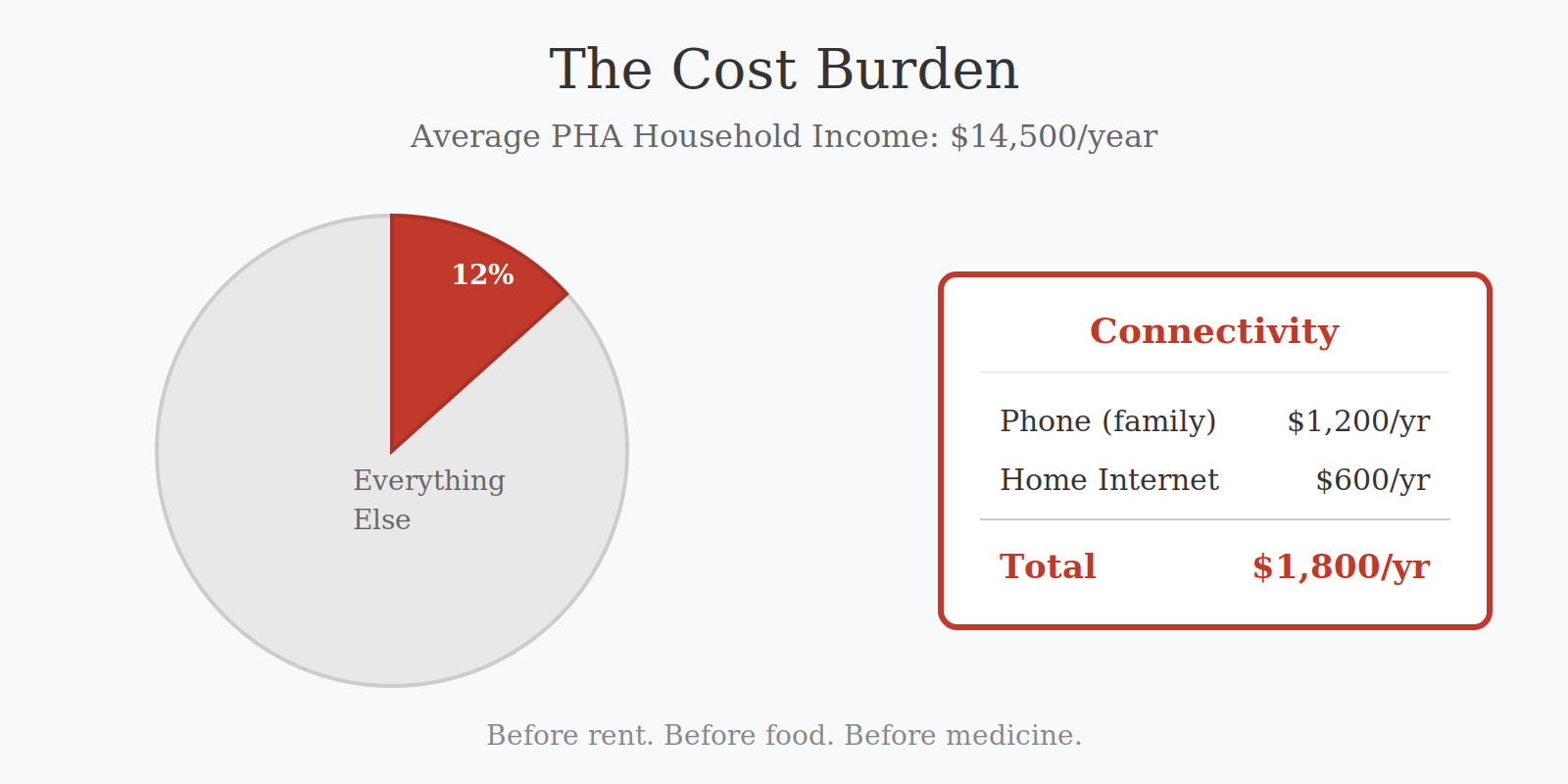
Low-income households spend 12% of income on connectivity. Phone plus internet costs $1,800/year on average. That's before rent, food, or medicine.

The Old Way
Traditional MDU wiring runs $700-1,200 per unit. CAT6 to every apartment, switches, access points, labor. The wiring cost dominates everything.
It's Been Done
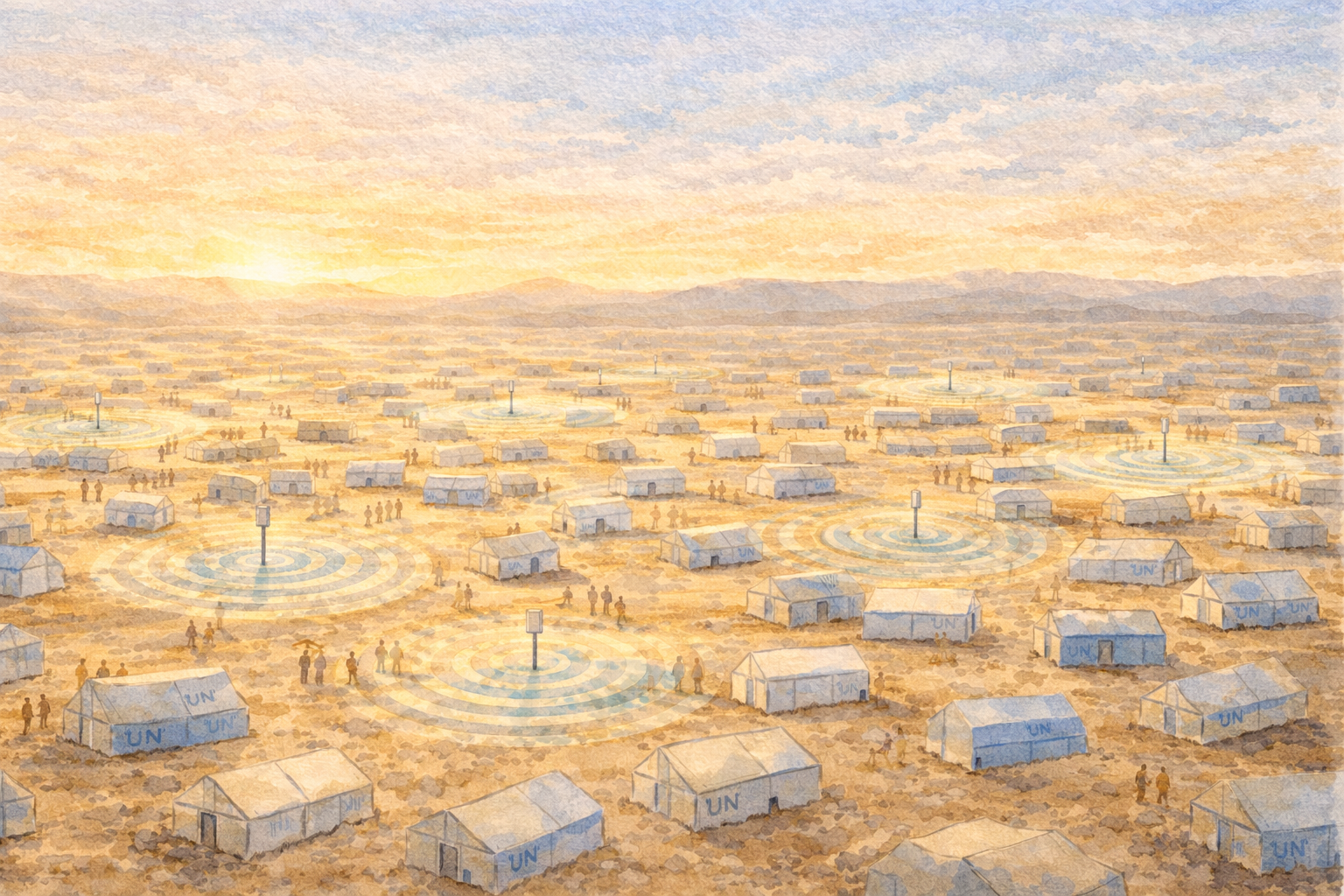
NetHope deployed WiFi to 76 refugee camps. 500,000 people connected. Outdoor access points, no wiring to individual structures. The approach works at scale.

Outside-In
Perimeter broadcast. Directional access points around the building, signal broadcasts inward through walls and windows. No wiring inside units. No truck rolls into apartments.

The Economics
$11-15 per unit delivers internet and a phone that works everywhere. With Lifeline subsidy, net cost drops to $6-8. Pricing to residents is determined by the operator.
District Concept
One infrastructure system. Multiple functions. Any defined geography.
The Utility Node
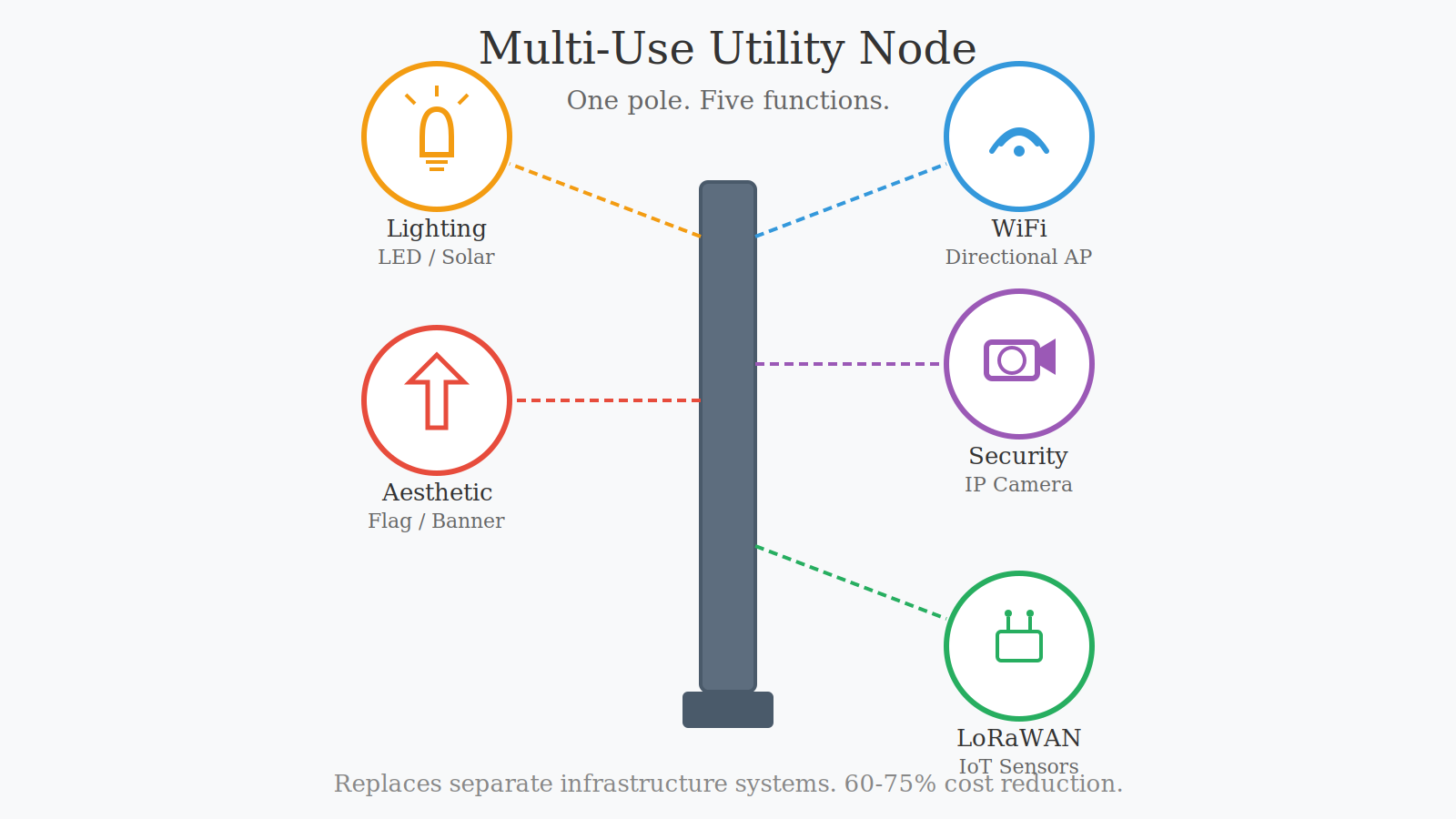
A single pole structure that combines WiFi, security, IoT sensors, lighting, and aesthetic elements. One installation serves five purposes that would otherwise require separate infrastructure, separate contractors, separate maintenance contracts.
| Function | Hardware | Purpose |
|---|---|---|
| WiFi | Directional outdoor AP | Connectivity for buildings, outdoor areas, visitors |
| Security | PTZ or fixed IP camera | District-wide surveillance, incident documentation |
| LoRaWAN | LPWAN gateway | IoT sensors - parking, foot traffic, environmental, equipment |
| Lighting | LED fixture | Street or area lighting, solar option available |
| Aesthetic | Flag, banner, architectural element | District identity, wayfinding, visual coherence |
One LoRaWAN gateway covers an entire district - range of 2-10 km urban, 10+ km rural. Sensors cost $15-50 each and run 5-10 years on a single battery. Applications include leak detection, temperature monitoring, door/window sensors, occupancy detection, parking availability, and equipment status.
The model applies at any scale where a defined geography needs connectivity and infrastructure.
| Application | Typical Scale | Nodes | Backbone |
|---|---|---|---|
| Church campus | 5-20 acres | 4-8 | Single connection |
| Housing property | 1-50 acres | 10-30 | Single connection |
| Urban district | 10-50 blocks | 20-60 | 1-2 connections |
| Greenfield development | 100-500 acres | 40-100 | Designed into site plan |
Smaller deployments use a single internet backbone with wireless distribution. Larger deployments may use multiple backbone connections for redundancy or capacity, but the architecture remains the same.
Traditional approach: separate procurement for each system.
| System | Typical Cost (50-acre district) |
|---|---|
| Campus WiFi network | $200,000-400,000 |
| Security camera system | $100,000-200,000 |
| Building automation/IoT | $75,000-150,000 |
| Exterior lighting | $50,000-100,000 |
| Total (separate systems) | $425,000-850,000 |
Integrated utility node approach:
| Component | Cost |
|---|---|
| Central backhaul | $15,000-30,000 |
| Utility nodes (20-40 units @ $3,000-5,000) | $60,000-200,000 |
| LoRaWAN sensors (200 units) | $10,000-20,000 |
| Management platform | $10,000-20,000 |
| Installation | $30,000-50,000 |
| Total (integrated) | $125,000-320,000 |
Projected savings: 50-70% compared to separate system procurement.
Beyond capital cost, integrated infrastructure means one maintenance contract instead of four, one management platform instead of four separate dashboards, and coordinated upgrades instead of patchwork replacement.
The utility node model works for existing districts and new construction, with different considerations for each.
Adding infrastructure to an existing urban district, campus, or property:
- Node placement works around existing buildings and utilities
- Building orientation is fixed - node positioning compensates
- Permitting may require coordination with multiple authorities
- Phased deployment possible - start with high-impact areas
The perimeter broadcast model was designed for retrofit. Outdoor nodes broadcast inward to existing buildings without interior wiring.
Designing infrastructure into a new development from the start:
- Building orientation optimized for RF penetration
- Node locations designed into site plan during architecture phase
- Conduit and power run during initial construction
- Window placement and wall materials specified for signal penetration
Greenfield deployments achieve better coverage at lower cost because the infrastructure is integrated rather than added. Buildings face the nodes instead of nodes working around buildings.
The end result for people in the district:
Residents / Tenants:
- WiFi coverage throughout the district - buildings, outdoor areas, common spaces
- Phone service that works everywhere (VoIP over WiFi or data SIM)
- Well-lit streets and common areas
Property Management / District Authority:
- Security camera coverage with centralized monitoring
- IoT sensor data - occupancy, environmental, equipment status
- Single management platform for all systems
- Reduced maintenance complexity
Visitors / Public:
- Guest WiFi access
- Wayfinding (if enabled)
- Safe, well-lit environment
The district becomes a connected place. Infrastructure fades into the background - the poles look like street furniture, not technology. But everything works.
Full Reports
Complete documentation for detailed review.
Literature Review
Published research on RF propagation through building materials.
Stone, W.C., National Institute of Standards and Technology
"Electromagnetic Signal Attenuation in Construction Materials"
DOI: 10.6028/NIST.IR.6055
The foundational government study on RF penetration through construction materials. Key findings at frequencies relevant to WiFi (2.4 GHz and 5 GHz):
| Material | Attenuation (dB) | Notes |
|---|---|---|
| Drywall/Gypsum board | <1 dB | Near-transparent to RF |
| Plywood | <1 dB | Minimal attenuation |
| Glass (standard) | 2-3 dB | Low attenuation |
| Brick (single) | 4-8 dB | Moderate attenuation |
| Concrete (8" solid) | 10-15 dB | High; varies with moisture |
| Concrete block (hollow) | 4-8 dB | Less than solid concrete |
| Reinforced concrete | 15-25 dB | Steel rebar adds loss |
NIST tested samples cured for 28 days. Later German studies (Pauli & Moldan, 2015) found concrete loses 5 dB of attenuation between 1-month and 9-month curing, suggesting aged construction may be more RF-permeable than laboratory samples.
International Telecommunication Union - Radiocommunication Sector
"Effects of Building Materials and Structures on Radiowave Propagation
Above About 100 MHz"
The international standard for modeling RF propagation through building materials. Provides frequency-dependent permittivity and conductivity equations for common materials, multi-layer slab transmission models, and building entry loss reference models.
2.4 GHz penetrates building materials better than 5 GHz due to longer wavelength. For wood-frame construction with drywall interior, cumulative wall losses of 3-8 dB are typical at 2.4 GHz.
Key equation for real relative permittivity: ε' = af^b
Where f = frequency in GHz, and a,b are material-specific constants
from Table 3 of the standard.
Journal of Computer and Communications, Vol. 12 No. 5
DOI: 10.4236/jcc.2024.125001
Peer-reviewed experimental study measuring electric field strength through various materials:
| Condition | E-field Reduction | Frequency |
|---|---|---|
| Concrete wall (30cm) | 55-70% | 2.4 / 5 GHz |
| Glass window | 10-15% | Both |
| Line-of-sight (2m → 6m) | 46% | Both |
Key finding: "Wi-Fi signal penetration is more pronounced at lower frequencies (2.4 GHz) as opposed to the Wi-Fi signal 5 GHz."
Public housing construction in Alabama (and nationally) falls into several categories with different RF characteristics.
| Construction Type | Typical Era | RF Penetration | % of Stock (est.) |
|---|---|---|---|
| Wood-frame with vinyl/brick veneer | 1970-present | Good (windows critical) | 40-50% |
| Concrete block (CMU) | 1960-1980 | Moderate (8-12 dB loss) | 25-35% |
| Brick masonry | 1950-1970 | Moderate (8-15 dB loss) | 10-20% |
| Steel/concrete high-rise | 1960-1980 | Poor (15-25+ dB loss) | 5-10% |
Hypothesis 1: Garden-style apartments with wood-frame or brick-veneer construction (majority of Alabama PHA stock) will support outside-in WiFi deployment. High-rise concrete/steel structures may not be viable for this model.
Hypothesis 2: The perimeter broadcast model has not been commercially deployed in permanent housing because: (a) The incumbent model (per-unit wiring) is established and understood by contractors, (b) Public housing has not been a priority market for WiFi providers, (c) No entity has tested this approach systematically in permanent construction.
This is a market gap, not necessarily a technical barrier.
Service Architecture
Where the internet comes from. Where the phone service comes from. What residents provide.
Two options for getting bandwidth to the property:
Option 1: Commercial DIA (Dedicated Internet Access)
Buy a fiber connection directly to or near the property from AT&T, Lumen, Spectrum, or regional carriers. Current pricing for 1 Gbps on a 3-year term runs approximately $1,300/month in most markets.
Option 2: WISP Model (Wireless ISP)
One fiber connection at a central location (tower, tall building) distributes wirelessly to multiple properties. Point-to-point or point-to-multipoint radios (Ubiquiti, Cambium, Tarana) link the backbone to each property rooftop.
| Model | 10 Properties | 50 Properties |
|---|---|---|
| DIA per property | $13,000/month | $65,000/month |
| WISP (one backbone) | $1,300/month | $1,300-2,600/month |
The WISP model makes costs nearly fixed while revenue scales with units served. Add properties by adding antennas, not negotiating new fiber drops.
FCC broadband standard is 100 Mbps down / 20 Mbps up. Nobody delivers dedicated 100 Mbps to every unit simultaneously - all providers use oversubscription.
| Oversubscription | 1,000 Units Needs | 4,000 Units Needs |
|---|---|---|
| 20:1 (typical cable) | 5 Gbps | 20 Gbps |
| 15:1 (conservative) | 6.7 Gbps | 27 Gbps |
| 10:1 (peak hours) | 10 Gbps | 40 Gbps |
Affordable housing demographics differ from general market: 40% seniors/disabled (lower usage), 15-20% non-adopters, lower 4K streaming adoption, less work-from-home video conferencing. Real-world oversubscription closer to 15:1 or 20:1.
1 Gbps serves approximately 500-1,000 units comfortably. 10 Gbps serves 4,000+ units with headroom. Pricing at scale: 10 Gbps DIA runs $3,700-6,000/month.
Demarc (demarcation point) is where carrier responsibility ends and yours begins. The carrier delivers fiber and terminates it. Your equipment connects there - router, switch, wireless distribution gear.
Location options:
- Utility closet in main property building
- Equipment cabinet at tower base (WISP model)
- Carrier handoff in nearby lit building
Proximity to existing fiber infrastructure affects cost dramatically. A connection two blocks from a carrier hotel costs far less than one requiring a 10-mile fiber build.
Residents get a real phone number that works everywhere - home, work, the bus, anywhere with WiFi or cellular data. This is VoIP (Voice over IP), not traditional cellular service.
How it works:
- SIP trunking provider (Twilio, Telnyx, VoIP.ms) assigns phone numbers
- Resident downloads a softphone app (Linphone, Zoiper, or white-label)
- Calls route over internet - property WiFi at home, data SIM elsewhere
| Component | Provider Examples | Cost |
|---|---|---|
| Phone number (DID) | Telnyx, Twilio, VoIP.ms | $1-2/number/month |
| Per-minute usage | Same providers | Fractions of a cent |
| Softphone app | Linphone (open source), Zoiper | Free |
At scale, the VoIP platform can be self-hosted (FreePBX/Asterisk on your own server) or cloud-hosted through the trunk provider. Self-hosted adds control; cloud-hosted reduces operations burden.
Lifeline subsidy ($9.25/month) applies to phone service, not broadband. This is intentional - FCC broadband Lifeline requires 100/20 Mbps guaranteed per subscriber, which creates compliance burden disproportionate to benefit.
VoIP phone service qualifies for Lifeline with simpler requirements: 1,000 minutes/month minimum. The provider becomes an Eligible Telecommunications Carrier (ETC) through FCC filing - timeline approximately 4-8 months.
Internet becomes a value-add amenity, not a regulated Lifeline service. Phone carries the subsidy.
VoIP requires internet connectivity. At home, that's property WiFi. Away from home - at work, on the bus, when the truck breaks down - that's the data SIM.
What it is: A data-only SIM card that provides cellular data for the VoIP app. Not a traditional phone plan - no voice minutes, no texts through the carrier. Just data for the app.
| Provider Type | Model | Cost |
|---|---|---|
| IoT wholesale (Transatel, Onomondo) | Pooled data | $3-5/SIM/month |
| Retail MVNO (Tello, US Mobile) | Individual plans | $5-10/SIM/month |
IoT wholesale providers offer pooled data across all SIMs. If some residents use less, others can use more. At scale (5,000+ SIMs), you're a real customer and can negotiate better rates.
VoIP uses approximately 1 MB per minute of talk. 500 minutes of calls = 500 MB of data. Most residents won't use anywhere near 1 GB for voice alone.
This is phone service, not unlimited streaming. The data SIM keeps the phone working when residents are away from WiFi. Heavy data usage (video, music, social media) happens on property WiFi, not the cellular data SIM.
We are not in the business of selling phones.
Most residents already have a smartphone - even a $50 Android from Walmart runs VoIP apps. The phone they have becomes their connected phone.
Resident provides:
- Their existing smartphone (any Android or iPhone)
- Ability to download and use an app
We provide:
- WiFi coverage at the property
- Phone number and VoIP service
- Data SIM for connectivity away from home
For residents without a smartphone, basic Android devices are available under $50. Some Lifeline providers include a free phone with enrollment. But that's their acquisition, not ours - we don't inventory or distribute hardware.
This is not a premium fiber-to-the-unit service. This is functional connectivity for people who currently have none or pay too much for unreliable service.
What residents get:
- Internet at home - shared bandwidth, adequate for typical usage
- Phone that works everywhere - real number, VoIP over WiFi or cellular data
- No contract, no credit check, no surprise bills
What this is not:
- Guaranteed 100/20 Mbps per unit (we use oversubscription like everyone)
- Unlimited cellular data (the SIM is for phone service, not streaming)
- IT support for resident devices (we deliver signal, not tech support)
Clear boundaries prevent support burden from consuming operations margin.
| Our Responsibility | Not Our Responsibility |
|---|---|
| Signal to building perimeter | Inside-unit WiFi coverage |
| Outdoor infrastructure | Resident-owned devices |
| Bandwidth to property | Individual device configuration |
| VoIP service and phone number | App installation support |
| Data SIM provisioning | Resident's phone hardware |
Optional in-unit WiFi extenders available at cost (~$25). We don't support the extender - we sell it. Residents who need better coverage inside their unit handle their own solution.
Economics
Unit economics, portfolio scale, and funding context.
Traditional MDU WiFi wiring runs $700-1,200 per unit. CAT6 to every apartment, switches, access points, labor. At 4,000 units, that's $2.8M-$4.8M in capital before the first resident connects.
EducationSuperHighway documented this across 50+ competitive bids (2021-2024). The hotel-style approach (hallway APs) still runs $650/unit because interior wiring dominates the cost.
For affordable housing operators, those numbers don't pencil. The connectivity gap persists not because the technology doesn't exist, but because the economics don't work at traditional wiring costs.
Perimeter broadcast eliminates interior wiring. Operating cost per unit per month:
| Component | Cost |
|---|---|
| WISP internet (backbone share) | $5 |
| Data SIM (pooled IoT wholesale) | $3-5 |
| VoIP platform | $1-2 |
| Operations | $2-3 |
| Total Operating Cost | $11-15/unit |
With Lifeline subsidy ($9.25 applied to VoIP), the phone component is covered. Net operating cost drops to $6-8/unit.
The resident gets internet at home and a phone that works everywhere — not just on WiFi. The data SIM means connectivity at work, on the bus, wherever they are.
Two revenue streams per unit:
| Source | Amount | Notes |
|---|---|---|
| Service fee | $20/unit | Paid by housing operator from operating funds |
| Lifeline subsidy | $9.25/unit | FCC program for eligible residents |
| Total Revenue | $29.25/unit | Monthly, per occupied unit |
The $20 service fee compares favorably to bulk internet pricing ($30-45/unit for internet only). Operators get internet plus phone service at a lower cost than internet alone from traditional providers.
Lifeline qualification is automatic for public housing residents. The National Verifier system confirms eligibility through database matching with federal programs (Section 8, Medicaid, SNAP, SSI).
| Metric | Without Lifeline | With Lifeline |
|---|---|---|
| Revenue | $20.00 | $29.25 |
| Operating Cost | $11-15 | $6-8 |
| Margin | $5-9/unit | $21-23/unit |
Lifeline changes the economics substantially. At $21-23/unit margin, this becomes a meaningful revenue line, not a break-even amenity.
Unit economics matter. Portfolio economics change the conversation.
| Portfolio Size | Monthly Margin | Annual Margin |
|---|---|---|
| 500 units | $10,500-11,500 | $126K-138K |
| 1,000 units | $21,000-23,000 | $252K-276K |
| 4,000 units | $84,000-92,000 | $1.0M-1.1M |
| 10,000 units | $210,000-230,000 | $2.5M-2.8M |
| 25,000 units | $525,000-575,000 | $6.3M-6.9M |
Alabama has 26,000+ public housing units. A regional operator with 10,000 units generates $2.5M+ annually from connectivity services that previously cost money rather than making it.
At 25,000 units, this is a $6M+ annual business line with infrastructure already in place and residents already enrolled.
Perimeter broadcast CapEx versus traditional wiring:
| Approach | CapEx/Unit | 1,000 Units | 4,000 Units |
|---|---|---|---|
| Traditional wiring | $700-1,200 | $700K-1.2M | $2.8M-4.8M |
| Perimeter broadcast | $40-70 | $40K-70K | $160K-280K |
At $40-70/unit CapEx and $21-23/unit monthly margin, payback runs 2-3 months. Traditional wiring payback exceeds 3 years at the same margin.
The risk profile differs by an order of magnitude. A failed pilot at 100 units costs $4,000-7,000 in perimeter broadcast equipment versus $70,000-120,000 in traditional wiring.
The Broadband Equity, Access, and Deployment (BEAD) program provides $42.5 billion nationally. MDU WiFi infrastructure is explicitly listed as an eligible use.
If BEAD or other grant funding covers CapEx:
- Zero capital at risk
- Day-one positive margin
- Pilot becomes pure validation, not financial gamble
Even without grant funding, the CapEx-to-margin ratio supports rapid payback. With grant funding, the economics become essentially risk-free.
State broadband offices are actively seeking shovel-ready MDU projects. A validated perimeter broadcast model with documented performance data positions well for funding allocation.
Validation Methodology
Field testing protocol before capital commitment.
Each candidate building requires assessment before capital commitment.
- Determine construction type from building records
- Identify wall materials, window placement, floor count
- Flag buildings likely unsuitable (concrete high-rise, metal siding)
- Place temporary outdoor AP at proposed mounting location
- Measure received signal strength inside representative units (center, corner, ground floor, top floor)
- Document RSSI (Received Signal Strength Indicator) at multiple points within each test unit
- Record interference from competing WiFi networks
| Metric | Minimum | Target |
|---|---|---|
| RSSI at unit interior | -70 dBm | -60 dBm |
| Throughput at unit interior | 10 Mbps | 25 Mbps |
| Units meeting minimum | 70% | 90% |
For units failing minimum RSSI, test with $25 plug-in extender. Determine if extender brings unit to acceptable performance.
Clear definition of what the operator delivers vs. resident responsibility.
- Usable WiFi signal at building perimeter / exterior walls
- Connection to VoIP phone service
- Network monitoring and maintenance
- Optional purchase of in-unit extender if signal insufficient
- Troubleshooting their own devices
Avoids support burden of chasing signal complaints inside every apartment. Operator guarantees coverage to the building, not to every corner of every unit. This is similar to how cellular carriers operate: they guarantee coverage in an area, not inside every building.
- Select one garden-style apartment building (wood-frame, 20-50 units)
- Full RF survey, perimeter AP installation, performance measurement
- Document: cost, time, signal quality, resident feedback
- Deploy to 3-5 buildings of varying construction types
- Validate cost model at small scale
- Identify building types that work vs. require different approach
- Proceed with proven model
- Skip or modify approach for non-viable building types
- Scale based on validated economics
Africa Greenfield Application
New construction optimized for perimeter broadcast from design phase.
The primary feasibility study examines retrofitting existing PHA buildings. The same perimeter broadcast model applies to new construction with different characteristics.
| Factor | Retrofit (Alabama PHA) | Greenfield (Africa) |
|---|---|---|
| Building orientation | Fixed | Controllable |
| Wall materials | Survey each building | Specify during design |
| Utility node placement | Work around existing | Design into site plan |
| Window placement | Fixed | Orient toward AP locations |
In new construction, RF-friendly zones (window bands, covered walkways, courtyards) serve both climate-responsive ventilation and signal penetration. Brick construction with courtyards and brise-soleil screens creates architectural elements that also function as RF pathways.
Rather than separate infrastructure for WiFi, security, IoT, and lighting, a single mast incorporates all functions.
| Function | Hardware |
|---|---|
| WiFi broadcast | Directional outdoor AP |
| Security camera | PTZ or fixed IP camera |
| LoRaWAN gateway | LPWAN radio for IoT sensors |
| Lighting | LED fixture (solar option) |
| Aesthetic element | Flag, banner, architectural form |
| Parameter | Value |
|---|---|
| Range | 2-10 km urban, 10+ km rural |
| Sensor battery life | 5-10+ years |
| Gateway cost | $200-500 |
| Sensor cost | $15-50 each |
One gateway covers an entire district. Applications include temperature monitoring, leak detection, door/window sensors, occupancy detection, and equipment monitoring across hospital, university, housing, and grounds.
Traditional separate-system approach (estimated):
| System | Cost |
|---|---|
| Campus WiFi network | $800,000-1,200,000 |
| Security camera system | $300,000-500,000 |
| Building automation/IoT | $200,000-400,000 |
| Exterior lighting | $150,000-300,000 |
| Total | $1.45-2.4 million |
Integrated utility node approach (estimated):
| Component | Cost |
|---|---|
| Central backhaul | $50,000-100,000 |
| Utility masts (40-60 @ $3-5K each) | $150,000-250,000 |
| LoRaWAN sensors (500 units) | $25,000-50,000 |
| Management platform | $20,000-40,000 |
| Installation | $100,000-150,000 |
| Total | $345,000-590,000 |
Projected savings: 60-75% reduction in infrastructure capital cost. These are planning estimates requiring detailed engineering and vendor quotation.
Patent Analysis
Prior art research and potential novelty assessment.
Research conducted January 2026:
- Smart poles / multipurpose utility poles: Commercial products exist (Bivocom, Comba Telecom, Omniflow) combining WiFi, cameras, sensors, and lighting on streetlight poles for municipal smart city applications.
- Combined WiFi/LoRaWAN hardware: Milesight manufactures cameras with built-in LoRaWAN gateways.
- Outdoor WiFi for campus coverage: Enterprise campus WiFi with outdoor access points is standard practice.
- MDU managed WiFi: Commercial providers (Ruckus, Cambium, Dojo Networks) offer building-wide WiFi for apartments. All identified solutions use interior access points wired to hallways or units.
- Inward-directed perimeter broadcast: Smart city poles broadcast outward to streets. Prior art does not describe outdoor access points specifically oriented to broadcast inward through building walls to serve residential units without interior wiring.
- Residential aesthetic integration: Smart city poles are industrial infrastructure. The flagpole/architectural element approach appears distinct from municipal smart pole design.
- MDU-specific cost structure: The economic model targets affordable housing, comparing perimeter broadcast cost ($40-70/unit) against traditional wiring ($700-1,200/unit).
- Integrated property management: Combining WiFi delivery with LoRaWAN property management sensors and security cameras as a unified package for housing operators.
- Greenfield architectural integration: Designing building orientation, window placement, and construction materials to optimize RF penetration from pre-planned utility node locations.
| Option | Cost | Timeline |
|---|---|---|
| Provisional patent (small entity) | $130 | 12 months patent pending |
| Utility patent (small entity) | $3,000-6,000 | 2-4 years to issuance |
The provisional application establishes priority date. Conversion to utility patent follows if field results confirm viability.